Product Description
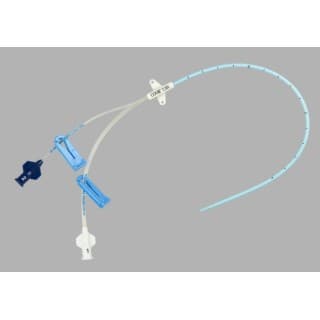
Cook Medical G26937 – TRAY, DBL POLYURETHANE CNTRL VENOUS CATH, EACH
Central Venous Catheter Tray – Double Lumen Polyurethane Catheter
Standard Trays – Polyurethane
| Order Number |
Reference Part Number |
Catheter Fr/Equiv. gage |
Catheter Length (cm) |
Wire Guide Diameter inch |
Suture Needle Shape |
| G26937 |
C-UDLMY-501J-RSC-CCT |
5.0/16 |
12 |
0.018/21 |
Straight |
Components
- Double Lumen Catheter
- Wire Guide, 40 cm long
- Dilator
- Catheter Access Needle
- Percutaneous EchoTip Entry Needle, 4 cm long
- Connecting Tube
- Suture Wing
- Needle Protector
- 6 cc Syringe
- 5 mL Lidocaine
- Braided Black Silk Suture (3-0)
- 22 Gage Needle
- 25 Gage Needle
- Safety Scalpel
- Gauze Sponges
- CSR Wrap
- Statlock
- Serrated Hemostat
- 36″ x 48″ Drape
- Slant Wire Guide Holder
- Plastic Clip
- Needle Vise Port
- 10 mL Saline Prefilled Syringes
- Microclaves
- Needle Holder Cup
- Filter Straw
- ChloraPrep
- 3 cc Retractable Syringes
- Insertion Form
Minipuncture Access Sets and Trays (denoted by – MNP)
Used for the insertion of 5.0 French or larger central venous catheters (single and multi-lumen) through the use of a 20 gage extra-thinwall access needle and a specially designed .025 inch diameter Amplatz Extra Stiff Wire Guide using percutaneous entry (Seldinger) technique. All Minipuncture central venous catheters have a removable inner cannula, which must be removed after introduction.
Micropuncture Access Sets and Trays (denoted by – MP)
Used for the insertion of central venous catheters (single and multi-lumen) through the use of a 22 gage access needle and a .018 inch diameter wire guide using percutaneous entry (Seldinger) technique. Most catheters for adult applications have a removable inner cannula, which must be removed after introduction.
Intended Use
The central venous catheter is designed for treatment of critically ill patients and is suggested for:
- Continuous or intermittent drug infusions
- Central venous blood pressure monitoring (CVP)
- Acute hyperalimentation
- Blood sampling
- Delivery of whole blood or blood products
- Simultaneous, separate infusion of drugs
Contraindications
Do not use heparin-coated central venous catheter in patients with a history of heparin-induced thrombocytopenia.
Precautions
- The catheter is intended for use by physicians trained and experienced in the placement of central venous catheters using percutaneous entry (Seldinger) technique. Standard Seldinger technique for placement of percutaneous vascular access sheaths, catheters and wire guides should be employed during the placement of a central venous catheter.
- Do not re-sterilize catheter.
- Do not cut, trim or modify catheter or components prior to placement or intraoperatively.
- Patient movement can cause catheter tip displacement. Use should be limited to controlled hospital situations. Catheters placed via an antecubital vein have shown forward tip movement of up to 10 cm with motion of the extremity. Catheters placed from either a jugular or subclavian vein have demonstrated forward tip movement of 1-3 cm with neck and shoulder motion.
- Catheter should not be used for long-term indwelling applications.
- If lumen flow is impeded, do not force injection or withdrawal of fluids. Notify attending physician immediately.
- Catheter should not be used for chronic hyperalimentation.
- Select puncture site and length of catheter needed by assessing patient anatomy and condition.
- Left subclavian and left jugular veins should be used only when other sites are not available
- Use of ECG, ultrasound and/or fluoroscopy is suggested for accurate catheter placement.
- For heparin coated devices, standard flushing procedures are recommended.
Technical Features
Standard Catheter Lengths Available for Adult Use
These suggested lengths must be viewed only as a guideline.
| French Size |
Length |
Access Site |
| 5.0 |
12 cm |
Right subclavian vein; for patients weighing 10-40 kg |
Double-Lumen Information
| French Size |
Lumens |
Equivalent Gage |
Minimum Lumen Volume |
| 5.0 |
#1
#2 |
20
20 |
0.2 ml
0.2 ml |
Instructions for Use
- If applicable, remove the Luer-lock end cap from each extension.
- Prepare the catheter for insertion by flushing each of the lumens and clamping or attaching the injection caps to the appropriate extensions. Leave the distal extension uncapped for wire guide passage. 3.
- Introduce thinwall percutaneous entry needle into vessel. Venous blood should be easily aspirated to confirm position of needle tip within vessel.
- Slide Safe-T-J wire guide straightener (positioned on distal tip of wire guide) over J portion of wire guide. Pass straightened wire guide through needle; advance wire guide 5-10 cm into vessel. If straight wire is used, always advance soft, flexible end through needle hub and into vessel.If resistance is encountered during wire guide insertion, do not force wire guide. Withdrawal of wire guide through needle should be avoided; breakage may result.
- While maintaining wire guide position, withdraw needle and Safe-T-J wire guide straightener.
- Enlarge puncture site with number 11 scalpel blade, if required. If dilation is required, dilator can be advanced over wire guide and removed prior to insertion of central venous catheter.
CAUTION: To avoid vascular injury, do not use excessive force when advancing dilators. Use the smallest size dilator catheter placement will allow. Wire guide must always lead dilator by several centimeters. Do not advance dilator more than a few centimeters into the vessel.
- Measure catheter to be used against patient to determine approximate length of catheter needed from puncture site to central venous tip position.
- Introduce the central venous catheter over wire guide. While maintaining wire guide position, advance catheter into vessel with a gentle twisting motion.
NOTE:Do not advance catheter tip beyond distal tip of wire guide. Always have wire guide leading during catheter placement. Verify catheter tip position using radiography or appropriate technology. In order to guarantee extrapericardial location, the catheter tip should be located above the SVC-RA junction, within the lower 1/3 of the SVC. Every effort must be made to ascertain proper tip position in order to prevent erosion or perforation of the central venous system and to ensure proper delivery of infusates.
- After catheter is in position, remove wire guide. (Fig. 2) Venous blood should be easily aspirated. Winged hub can now be sutured into place. If catheter is not introduced to its full length, additional suture should be carefully placed around catheter and affixed to the skin at entry site if movable suture wing is not included. This will help prevent backward or forward catheter movement. Lumens should now be flushed with 5-10 cc normal saline prior to use or establishment of heparin lock.
NOTE:A wire guide that is at least twice as long as the catheter is recommended for catheter exchange procedure.
How Supplied
Supplied sterilized by ethylene oxide gas in peel-open packages. Intended for one-time use. Sterile if package is unopened or undamaged. Do not use the product if there is doubt as to whether the product is sterile. Store in a dark, dry, cool place. Avoid extended exposure to light. Upon removal from package, inspect the product to ensure no damage has occurred.
Caution:U.S. federal law restricts this device to sale by or on the order of a physician (or properly licensed practitioner).